


On 2 December, the IM⁴CA project held its first General Stakeholder Meeting in Brussels
Participants from policymaking, NGOs, national reporting agencies, academia, and industry joined the round table to share perspectives on strengthening methane-related climate action and develop future collaboration.
The programme featured speakers from diverse backgrounds, addressing a wide range of scientific, policy, and technological topics relevant to methane mitigation.


The meeting opened at 9:00 with a tour de table and a welcome from Prof. Sander Houweling (VUA), IM⁴CA coordinator, who introduced the project’s objectives, expected outcomes, and relevance for the diverse stakeholder groups in attendance.
The first scientific contributions followed, beginning with Lena Höglund Isaksson (IIASA), who presented a quantitative analysis based on the GAINS model contribution to the upcoming UNEP/CCAC Global Methane Status Report 2025.
She was followed by Thomas Stoerk (National Bank of Belgium), who summarized findings from his recent Science study demonstrating that global methane mitigation delivers economic benefits at least six times greater than its costs. A short Q&A concluded this session.
After the break, the focus shifted to policy and monitoring frameworks. Stefanie Lumnitz (EC, DG R&I) outlined the scientific needs underpinning evidence-based methane policy in both the global and EU regulatory context.
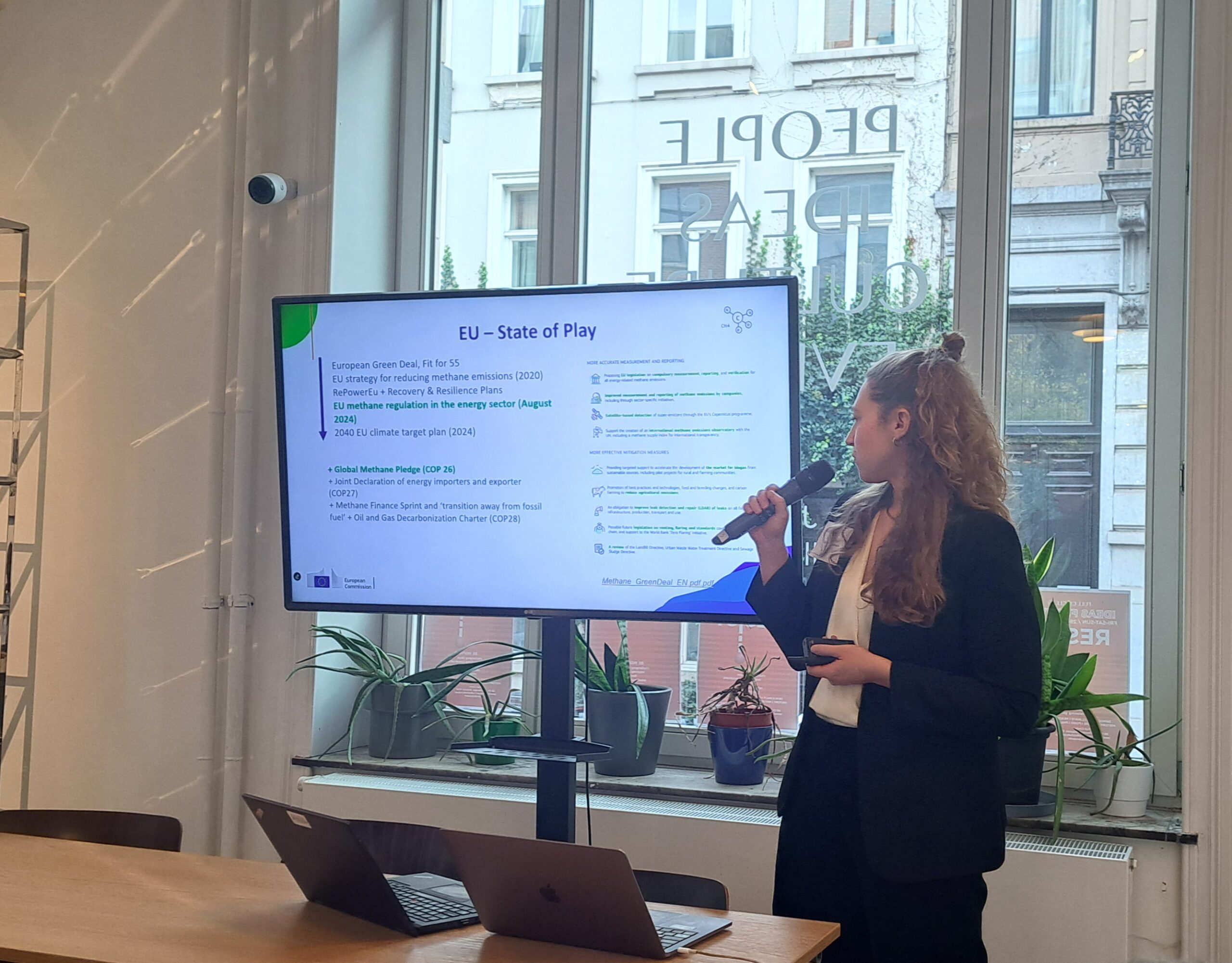
Edward Malina (ESA) highlighted Earth-observation capabilities for methane detection, showcasing ESA missions and related EU/ESA projects such as SMART-CH4, IM⁴CA, AVENGERS, and others.
This was followed by Christian Mielke (UBA), who stressed the importance of sustained funding and continuous measurements to support verification of national greenhouse-gas inventories.

The session continued with Andreea Calcan (IMEO), who presented UNEP IMEO’s work linking improved satellite measurements with targeted mitigation actions. She provided insights into the Oil and Gas Methane Partnership 2.0, its role in informing the EU Methane Regulation (2024), and the Methane Alert and Response System (MARS).
The morning concluded with Carles Debart (GHGSat), who presented their operational constellation of 15 satellites and demonstrated methane hotspot detections across several European countries.

Following lunch, Janek Vahk (Zero Waste Europe) discussed methane emissions from the waste sector, reviewing EU trends and recommending actions to reduce landfill emissions through improved waste quality, treatment technologies (e.g., separating organic waste before landfilling), and economic incentives.
The final presentation was delivered by Ben Poulter (Spark Climate Solutions), who shared insights from the Global Methane Budget, with a focus on natural emissions from wetlands and related climate feedbacks, identifying several promising synergies with IM⁴CA and opportunities for further collaboration.
The final session was dedicated to a panel discussion, composed of (from left to right in the photo): Ilse Aben (SRON), Hannes Witt (RIVM), Ben Poulter (Spark Climate Solutions), and Brendan Devlin (EC, DG-ENER), moderated by Lena Höglund Isaksson (IIASA). The panel members had to reflect on topics related to:
- emission quantification (including uncertainties)
- policy action
- who else should have been here today?

The panel agreed that continued scientific efforts to reduce methane emission uncertainties are essential, particularly to support independent verification of national inventories. Horizon Europe projects (AVENGERS, EYE-CLIMA, PARIS) help maintain progress, as long-term monitoring remains underfunded. Speakers emphasized that independent measurements—especially satellite data—are crucial for regulation, since inventories alone are insufficient Agriculture remains a major challenge due to variable emission factors and weak incentives for change. Participants also noted that public visibility, direct measurements, and integrated TD/BU approaches are vital for effective mitigation and for shaping future climate policies.
Cooperation with organisations like IMEO was suggested as a way to support universities by acting as an intermediary between science and industry, promoting transparency and high-quality data for mitigation. While this approach works for some applications such as MARS, its suitability for the IM⁴CA campaign in Romania is a next challenge for the project to explore further in cooperation with IMEO.